How a Telegram Signal Copier Handles Every Order
October 27, 2026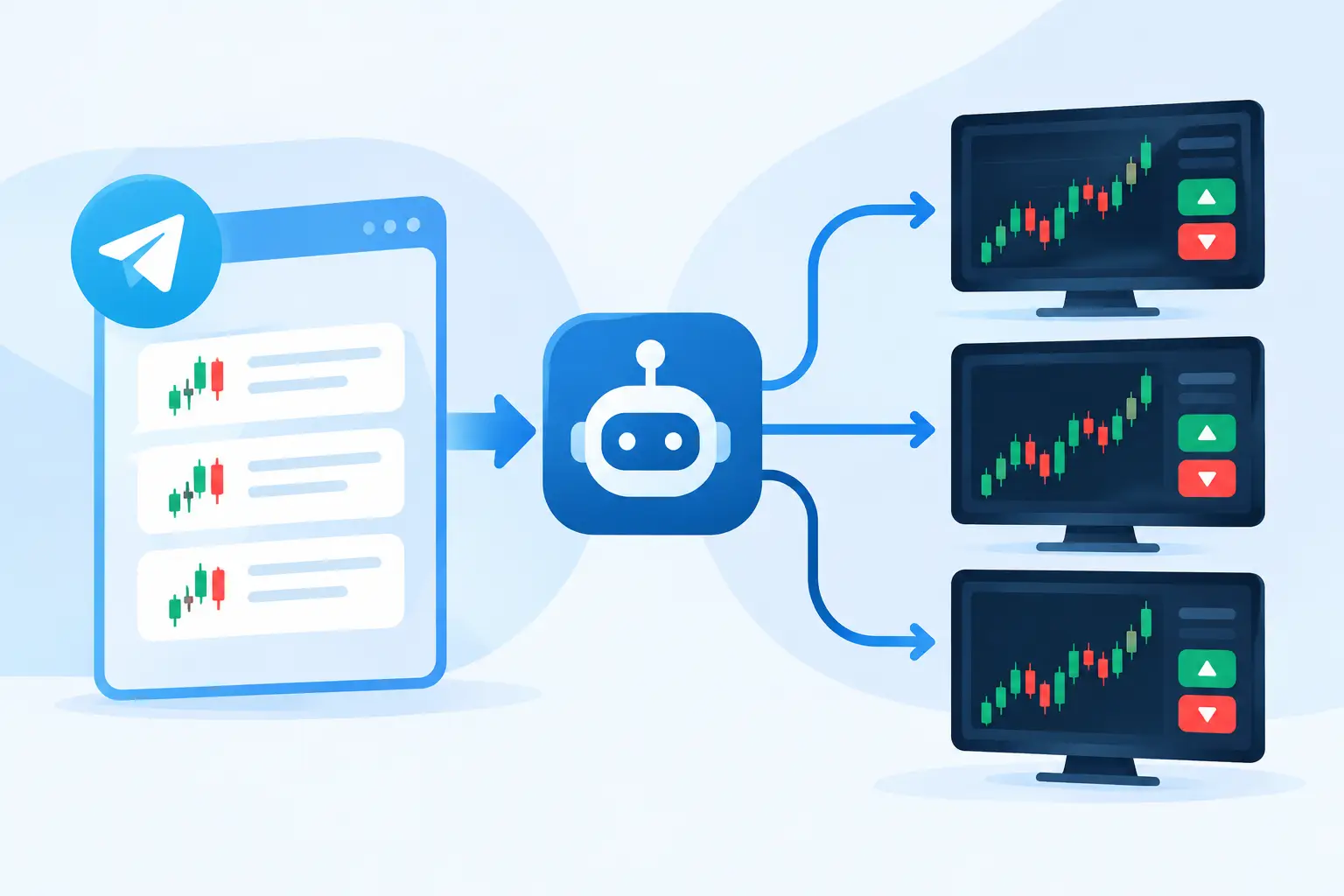
A Telegram signal arrives while you are commuting, asleep, or away from your desk. It says: “Buy XAUUSD 4250. SL 4244. TP 4262.” Copying it manually sounds simple until the market moves before you finish entering the order. A telegram signal copier is built to remove that gap between message and execution.
It monitors the channels you choose, reads the trading instruction, and sends the corresponding order to your own MT4, MT5, or TradeLocker account. The signal drops. The order goes.
That does not make the signal profitable or remove trading risk. It changes one operational issue: whether you can execute the selected signal source accurately and consistently, including when you are not watching Telegram.
What a Telegram Signal Copier Actually Does
At its core, a signal copier connects three separate environments: a Telegram channel, an execution engine, and your trading account. The channel publishes an instruction. The copier identifies the instrument, direction, entry type, volume rule, stop loss, take profit, and any later management message. It then submits an order through the connection to your broker account.
The useful distinction is between copying a trade and copying a message. A forwarder can send the Telegram alert somewhere else. A real copier must turn that text into broker-ready data. “Sell NAS100 now” is not yet an executable instruction unless the system knows how your broker names the symbol, what lot size to use, and what to do if the message includes several targets.
A capable copier can process market orders as well as pending limit and stop orders. It should also retain the relationship between the original signal and the order it created. That relationship matters when a channel later writes, “Move SL to BE,” “Close 50%,” or “Cancel pending order.” Without it, later instructions can be difficult to apply correctly.
Why Manual Copying Breaks Down
Manual execution is vulnerable to more than slow typing. You may read the message late, enter the wrong decimal place, choose buy instead of sell, or overlook an edited instruction. A rapid move can make the intended entry unavailable by the time you open your platform.
This becomes more noticeable with channels that publish at inconvenient hours or trade fast-moving instruments. Even a disciplined trader cannot react to every alert immediately. The problem is not a lack of effort. It is that the execution process depends on being present at the exact moment the message appears.
Automation cannot guarantee the entry price shown in a Telegram post. Market orders can fill at a different price because markets move, spreads change, and liquidity varies. Pending orders may not trigger at all. But an automated process can reduce the delay and transcription errors caused by moving from Telegram to a trading platform by hand.
Standard Parsing or AI Interpretation
Not every Telegram channel communicates in the same way. This is where the type of copier matters.
A rule-based system works well when the provider uses a stable, structured format. For example, each alert might always specify the asset, direction, entry, SL, and TP using the same labels. The copier can map those fields using defined rules. This approach is predictable and usually sufficient for channels that maintain discipline in their formatting.
The limitation appears when messages are less structured. A provider may write “gold looks ready for another push,” then follow it with “long around current levels, risk under 4240.” They may use shorthand, make a typo, change their format, or issue a partial-close instruction without referencing the original ticket.
AI interpretation is designed for these freer formats. Instead of matching only fixed fields, it evaluates the meaning and context of the message. That can help it recognize a revised stop loss, a breakeven instruction, or an order-management update written in natural language.
AI is not a reason to stop checking how a channel communicates. It is an execution layer, not a substitute for judgment. Before connecting a live account, test real examples from the selected channel. Check how it handles symbols, targets, updates, and unclear messages. If an alert is ambiguous, a careful setup should favor caution over inventing an order.
The Setup Details That Matter Most
A telegram signal copier is only as reliable as its configuration. The first task is to choose the specific Telegram channels to monitor. You should only connect sources you are authorized to access and whose messages you understand.
Next, connect the trading account. The copier needs a secure method to place orders on your behalf, but it should not need permission to withdraw funds. Confirm that your broker and account type are supported, whether on MetaTrader 4, MetaTrader 5, or TradeLocker.
Then define the execution rules. This is where a generic channel message becomes an order aligned with your account. In most cases, you need to decide:
- how volume is calculated, such as a fixed lot size or a rule based on balance
- how channel symbols map to your broker symbols
- whether to use every take-profit target or only selected targets
- what to do when the stated entry is already too far from the current price
- whether management messages can modify positions opened by the copier
Those settings are not minor details. A signal provider might write “EURUSD,” while your broker uses “EURUSD.a” or another suffix. An index might have a completely different broker symbol. Correct symbol mapping prevents an otherwise valid signal from being rejected or, worse, applied to the wrong instrument.
Use a test environment before going live. A browser-based signal tester lets you paste channel messages and see how the system interprets them without placing a trade. MullTrade's signal tester checks opening signals this way before you choose a plan. Management messages, such as a move to breakeven or a partial close, can be checked during the free trial. Check them too: management instructions are often where a weak setup becomes visible.
What Happens After the First Order
Opening a trade is only part of the workflow. Many signal providers actively manage positions. They may close one target, move the remaining stop to breakeven, reduce exposure before news, or cancel a pending order that no longer applies.
For a copier, this requires state awareness. It must know which account position came from which Telegram signal and whether the broker accepted the original order. If a provider says “close half,” the system needs a clear rule for calculating the partial close within the volume constraints of the trading account.
There are practical limits. A broker can reject an order due to insufficient margin, an invalid volume step, a closed market, or a symbol restriction. A stop loss may be too close to the current price for that broker. In volatile conditions, the original instruction can become impossible to reproduce exactly.
Good automation should report these cases clearly. Silent failures are expensive because they leave you assuming that an order exists when it does not. Review execution status, rejected orders, and symbol mappings regularly, especially during the first days after a new channel is connected.
Server-Based Execution Versus an EA or VPS
Some copying systems depend on an Expert Advisor running in MetaTrader. Others require you to rent and manage a VPS so the platform stays open around the clock. That model can work, but it adds another layer to maintain: installations, updates, terminal logins, connectivity, and server uptime.
A server-based copier handles the monitoring and execution infrastructure remotely. Your computer does not need to remain switched on. This is particularly useful if you trade from a phone, use a Mac, or simply do not want to manage a VPS.
The trade-off is that you are trusting a third-party service with execution access. Review its security approach. Credentials should be encrypted, access should be limited to what is required for trading, and account connections should be designed so funds cannot be withdrawn. If your broker restricts access by IP address, an optional fixed residential IP can also be relevant.
Billing terms matter too. A fixed-duration subscription paid upfront is easier to assess than a plan that silently renews. Know what happens at the end of the license period, whether you can test your channel before paying, and which plan supports the format your provider actually uses.
Risk Still Starts With the Signal Source
A copier executes instructions. It does not evaluate whether those instructions are sensible, whether the channel has a credible track record, or whether the position size fits your financial situation. Those decisions remain yours.
Treat every selected Telegram channel as a separate source of market risk. Review its history, understand its approach to drawdowns, and set lot sizing that your account can absorb. A fast copier can execute a poor signal just as efficiently as a good one.
Start with a small allocation and observe real behavior across normal market conditions. Check how pending orders, multiple targets, and breakeven messages appear in your account. Once you know the execution rules match the way the channel communicates, automation can do what it is supposed to do: remove the mechanical delay and leave you more time to manage the decisions that still require a trader.