How to Copy Telegram Signals Without a VPS
November 1, 2026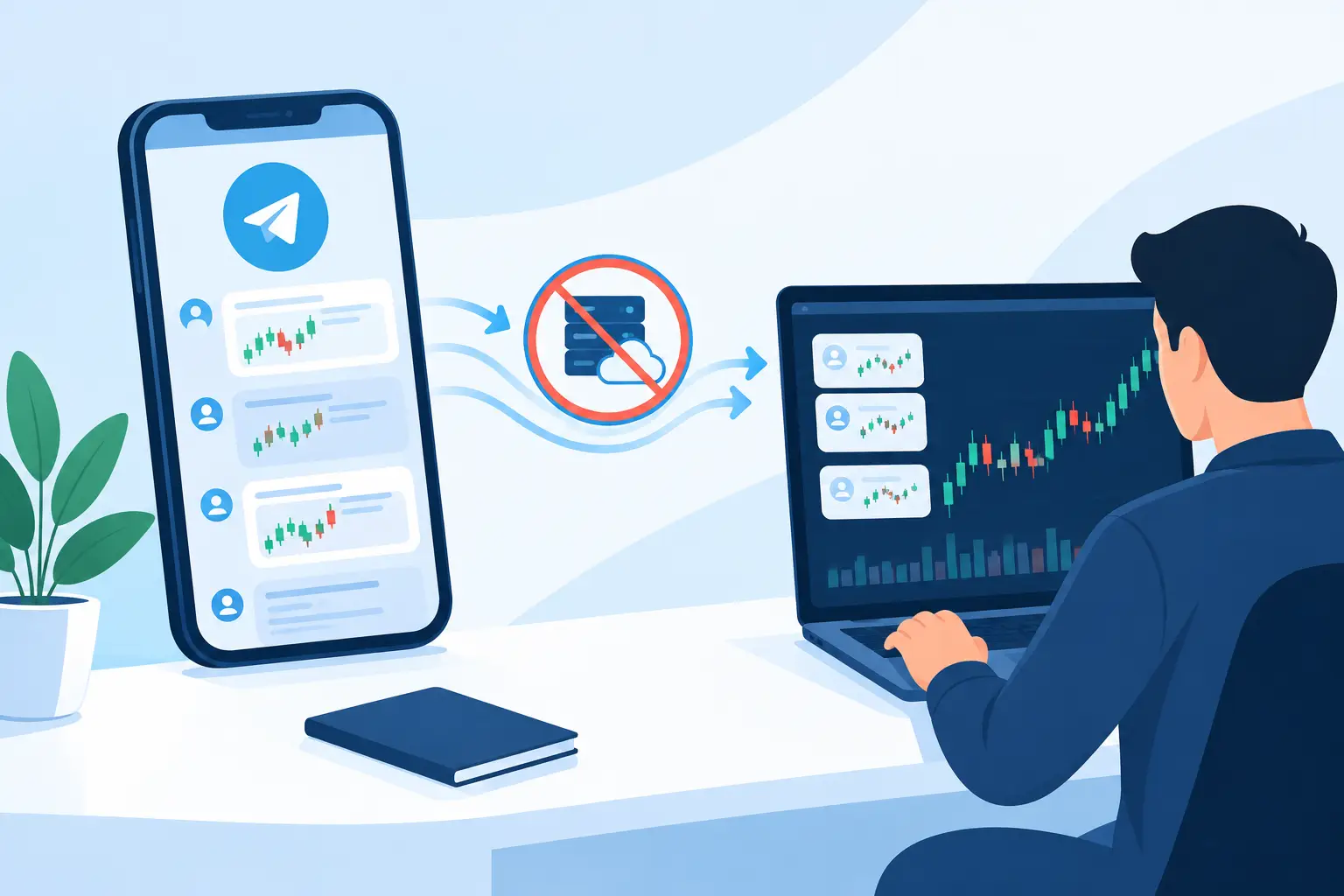
A signal posted at 2:17 a.m. is not useful if you see it at 7:00 a.m. For traders who follow Telegram channels, the practical challenge is execution: reading the message quickly, entering the right symbol and direction, setting the correct SL and TP, then staying available for later updates. The ability to copy Telegram signals without a VPS removes a layer of infrastructure while keeping the execution process active around the clock.
The goal is not to make trading automatic in the vague sense. It is to turn a defined Telegram instruction into a defined order on your own MT4, MT5, or TradeLocker account. The signal drops. The order goes.
Why a VPS used to be part of the setup
Traditional signal copying usually relies on an Expert Advisor installed inside a desktop MetaTrader terminal. That terminal needs to remain open and connected. A VPS becomes the usual answer because a home computer can restart, lose its connection, enter sleep mode, or simply be turned off.
That arrangement works for some traders, but it adds moving parts. You need to choose a VPS provider, install MetaTrader, load the EA, enter account details, keep the terminal updated, and investigate whether the issue is the VPS, the EA, the broker connection, or the signal format when an order does not arrive.
It can also be inconvenient for traders who use a Mac or manage accounts mainly from a phone. They do not necessarily want to maintain a Windows environment just to copy a channel.
A server-hosted copier changes the architecture. Instead of running software on your computer, the automation service monitors the selected Telegram channel from its own infrastructure and connects to your broker account. Your device is no longer the component that must remain online.
How to copy Telegram signals without a VPS
The process starts with a Telegram channel and an existing trading account. You select the channel to monitor, connect an MT4, MT5, or TradeLocker account, and define the execution rules before the first live order is sent.
For a cleanly structured signal, a message such as “Buy EURUSD at market, SL 1.0800, TP 1.0900” can be read as an entry instruction. The automation maps the symbol to your broker, calculates the order size based on your settings, and sends the market order with its stop loss and take profit. Pending instructions can work in the same way when the message specifies a limit or stop entry.
The important distinction is that the service executes instructions. It does not choose trades, assess a provider’s strategy, or remove market risk. The quality and timing of the original signal still matter. Spreads, liquidity, broker symbol naming, account restrictions, and price movement between the message and execution can affect the resulting fill.
Set position size before signals arrive
Lot sizing should be a deliberate account-level decision, not an assumption taken from a Telegram post. A provider may publish a trade without a lot size, or may use sizing that does not suit your balance, leverage, or risk limits.
Configure a fixed lot size or a percentage-based risk setting according to the options available in your copier. Then test the configuration against representative messages before connecting a live account. This is where many avoidable mistakes are caught: a symbol alias, a missing stop loss, an unfamiliar channel format, or a rule that does not match how you intend to trade.
A good setup gives every account its own rules. If you copy the same channel to two accounts, their sizing, supported instruments, and risk tolerance do not have to be identical.
Match the channel format to the right parser
Some channels are disciplined. Every entry uses the same symbol, direction, entry type, SL, and TP layout. Rule-based parsing is well suited to these messages because the format is predictable.
Other channels are less consistent. A provider may write entries in plain language, change the order of fields, correct a typo in a follow-up post, or issue management instructions later. In these cases, an AI-based parser can interpret free-form wording instead of depending on one fixed template.
This difference matters after the initial entry. A message such as “move stop to breakeven” or “close part of the position” needs to be matched to the open trade and handled according to your account settings. For partial closes, the percentage executed should be the percentage you have configured, not an uncontrolled value taken from the channel.
Before subscribing, test actual examples from the channel you intend to follow. An entry-signal tester is useful for checking whether the symbol, direction, order type, SL, and TP are understood. It is not a substitute for validating every possible management instruction.
What stays online when you do not
Without a VPS, availability comes from the automation provider’s servers rather than your personal machine. Telegram monitoring, message interpretation, and broker communication continue even if your laptop is closed or your phone has no signal.
That does not mean every condition is outside your responsibility. Your broker account must remain active and authorized to trade. You need sufficient margin. The broker must accept the instrument and order conditions. If a market is closed, a price has moved beyond an acceptable level, or a broker rejects an order, no copier can force execution.
You should also consider how fast your selected channel publishes corrections. A copier can react only after it receives a message. It cannot act on information that was never posted, and it cannot guarantee that the broker will fill an order at the illustrative level shown in a message.
Security is part of the setup, not an afterthought
Connecting a trading account to an external execution service requires trust, so ask practical questions. Are credentials encrypted? Does the service require software on your device? Can you disconnect an account when needed? Is the service built to execute trades only, rather than handle deposits or withdrawals?
With MullTrade, credentials are encrypted and the service runs on its own servers. There is no desktop installation, VPS, or EA to maintain. An optional fixed residential IP is available for traders whose broker connection setup requires a consistent source IP. It should be used within your broker’s terms and account rules.
The absence of local installation is useful, but it does not remove the need to protect your Telegram account, broker login, and recovery methods. Use strong unique passwords and review the connected accounts and channels before enabling execution.
The trade-offs of skipping a VPS
A hosted copier is simpler than a self-managed VPS, but it is not the right answer for every workflow. If you need to run a highly customized desktop EA, test local indicators, or control every terminal-level setting yourself, a VPS may still be appropriate.
The hosted approach is strongest when the job is straightforward: watch Telegram, interpret the message, and place the corresponding order on a supported account. It reduces maintenance and removes dependence on your home computer, but it also means choosing a service whose parsing, platform support, and risk controls match your channels.
Pricing structure matters too. Check whether a plan renews automatically, what is included in each parsing level, and whether you can validate signal compatibility before paying. Fixed-duration licenses and a browser-based tester make it easier to assess the setup without building a server first.
A practical pre-live checklist
Before enabling live execution, confirm four things: your Telegram channel is the correct one, your broker account is connected, your lot or risk settings are intentional, and several recent entry messages parse as expected. Then review whether the channel uses pending orders, multiple take-profit levels, symbol suffixes, or management updates.
Start with an account size and risk setting you understand. Watch the first executions closely. Automation removes manual typing and delay, but it should not remove oversight. Once the rules are clear and the connection is tested, you can let the infrastructure handle the repetitive part while you remain responsible for the trading decisions behind it.